


Dec
28
Algebra
ax2 + bx + c = y
Suppose you have ax2 + bx + c = y, and you are told to plug zero in for y. The corresponding x-values are the x-intercepts of the graph. So solving ax2 + bx + c = 0 for x means, among other things, that you are trying to find x-intercepts. Since there were two solutions for x2 + 3x – 4 = 0, there must then be two x-intercepts on the graph. Graphing, we get the curve below:
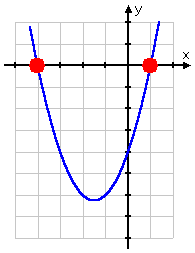
As you can see, the x-intercepts (the red dots above) match the solutions, crossing the x-axis at x = –4 and x = 1. This shows the connection between graphing and solving: When you are solving “(quadratic) = 0“, you are finding the x-intercepts of the graph. This can be useful if you have a graphing calculator, because you can use the Quadratic Formula (when necessary) to solve a quadratic, and then use your graphing calculator to make sure that the displayed x-intercepts have the same decimal values as do the solutions provided by the Quadratic Formula.
Note, however, that the calculator’s display of the graph will probably have some pixel-related round-off error, so you’d be checking to see that the computed and graphed values were reasonably close; don’t expect an exact match.
