


Dec
30
Hall effect
The Hall effect is the production of a voltage difference (the Hall voltage) across an electrical conductor, transverse to an electric current in the conductor and a magnetic field perpendicular to the current. It was discovered by Edwin Hall in 1879.[1]
The Hall coefficient is defined as the ratio of the induced electric field to the product of the current density and the applied magnetic field. It is a characteristic of the material from which the conductor is made, since its value depends on the type, number, and properties of the charge carriers that constitute the current.

For a simple metal where there is only one type of charge carrier (electrons) the Hall voltage VH can be derived by using the Lorentz force and seeing that in the steady-state condition charges are not moving in the y-axis direction because the magnetic force on each electron in the y-axis direction is cancelled by a y-axis electrical force due to the buildup of charges. The {\displaystyle v_{x}}

- {\displaystyle \mathbf {F} =q\left[\mathbf {E} +(\mathbf {v} \times \mathbf {B} )\right]}
- {\displaystyle 0=E_{y}-v_{x}B_{z}}
where {\displaystyle E_{y}}
is assigned in direction of y-axis, not with the arrow as in the image.
![\mathbf {F} =q\left[\mathbf {E} +(\mathbf {v} \times \mathbf {B} )\right]](https://wikimedia.org/api/rest_v1/media/math/render/svg/f0139e901d2aa4f20d3deb80a4e6dd56cd3321a6)
In wires, electrons instead of holes are flowing, so {\displaystyle v_{x}\rightarrow -v_{x}}


- {\displaystyle V_{H}=v_{x}B_{z}w}

The conventional “hole” current is in the negative direction of the electron current and the negative of the electrical charge which gives {\displaystyle I_{x}=ntw(-v_{x})(-e)}


- {\displaystyle V_{H}={\frac {I_{x}B_{z}}{nte}}}

If the charge build up had been positive (as it appears in some semiconductors), then the {\displaystyle V_{H}}
The Hall coefficient is defined as
- {\displaystyle R_{H}={\frac {E_{y}}{j_{x}B_{z}}}}

where j is the current density of the carrier electrons, and {\displaystyle E_{y}}
- {\displaystyle R_{H}={\frac {E_{y}}{j_{x}B}}={\frac {V_{H}t}{IB}}=-{\frac {1}{ne}}.}
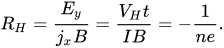
(The units of RH are usually expressed as m3/C, or Ω·cm/G, or other variants.) As a result, the Hall effect is very useful as a means to measure either the carrier density or the magnetic field.
One very important feature of the Hall effect is that it differentiates between positive charges moving in one direction and negative charges moving in the opposite. The Hall effect offered the first real proof that electric currents in metals are carried by moving electrons, not by protons. The Hall effect also showed that in some substances (especially p-type semiconductors), it is more appropriate to think of the current as positive “holes” moving rather than negative electrons. A common source of confusion with the Hall Effect is that holes moving to the left are really electrons moving to the right, so one expects the same sign of the Hall coefficient for both electrons and holes. This confusion, however, can only be resolved by modern quantum mechanical theory of transport in solids.[6]
The sample inhomogeneity might result in spurious sign of the Hall effect, even in ideal van der Pauw configuration of electrodes. For example, positive Hall effect was observed in evidently n-type semiconductors.[7]Another source of artifact, in uniform materials, occurs when the sample’s aspect ratio is not long enough: the full Hall voltage only develops far away from the current-introducing contacts, since at the contacts the transverse voltage is shorted out to zero.
